Academics are increasingly expected to make their research meaningful to time-poor politicians, policymakers, practitioners and citizens. Here, Deborah Talbot, Research Communications Specialist at CCRI, reflects on what good communications can do for academic projects, and why its funding needs to change.
Research communications are a relatively new add-on to academic research programmes. And many projects are curious to know how they can harness communications talent and integrate communications into research planning and impact.
Communications were core to the multi-million research programme UK Treescapes, a five-year transdisciplinary research programme coordinated here at CCRI, and which ended in 2025. Its aim was to understand the environmental and societal benefits of landscapes in which trees play a significant role.
On the 4th of December 2025, the CCRI team presented at the ESRC-UKRI Champions Network on the programme.
I kicked off with lessons from UK Treescapes, and Julie Urquhart (programme lead) and Alice Goodenough (programme manager) shared insights on where programme coordination aligned with communications reflections.
Insights from the Future of UK Treescapes
UK Treescapes’ communications were remarkably successful. The programme hosted many well-attended webinars and posted monthly newsletters with a readership of nearly 500 researchers, policymakers and practitioners.
It produced a range of end-of programme resources and events, including a professionally produced film, The Wonder of Treescapes, a professionally designed programme report, 31 Impact & Insights Notes, and a legacy website hosting all of these assets.
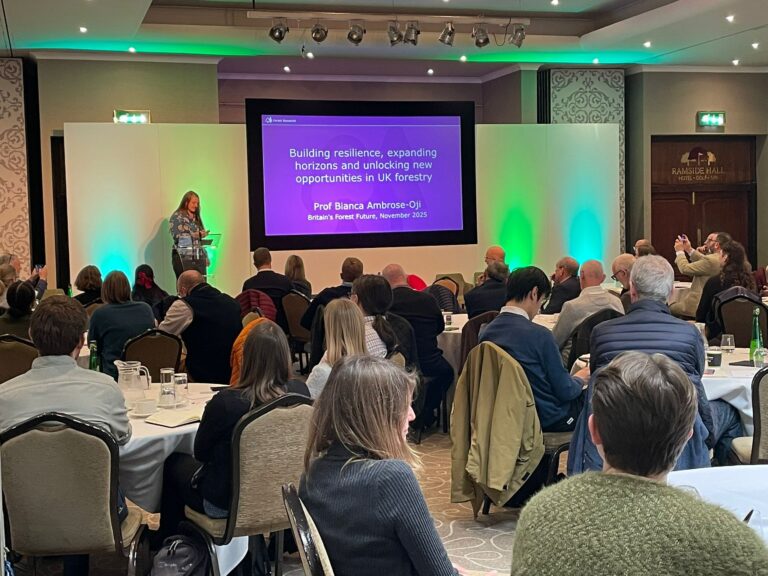
It also held an impactful joint Defra, UK Treescapes and Centre for Forest Protection two-day conference, Britain’s Forest Future: Research-Practice Exchange, in Durham on the 17th and 18th November.
So, what did we learn from UK Treescapes and discussions at the Champions Network event?
Communications matters
The right place to start, therefore, is perhaps an obvious fact that research communications matters. Research and science are questioned like never before and critical societal debates around biodiversity and climate change are highly polarised. Enabling the wider public to understand what you are doing, as well as building strong research communities or networks, is vitally important.
Because the function of comms is to communicate with diverse audiences in an intentional way, it has the capacity to cut through and make research meaningful to time-poor politicians, policymakers, practitioners and citizens. And, because of this, it can make connections and bring people together.
This ability to bring people together was very evident at the Britain’s Forest Future event, which facilitated dialogue between researchers, policymakers and forestry practitioners. Everyone had a great time!
Be strategic
It’s tempting, in the whirl of multiple research applications, to apply a pick and mix approach to comms – a little bit of social media, a newsletter, a website and a few blogs – without necessarily thinking about whether these things are worth the investment.
Far better to think in depth about who your audiences are, what your goals are, what are the messages you really want to convey and how can you package them to be meaningful to different audiences.
One attendee at the Champions Network commented that their project had integrated a ‘theory of change’ – defining the change they wanted to make and outlining the steps to get there. Combining this idea with a comms perspective can be incredibly powerful.
It’s also the case that standard methods for communicating might not be working so well anymore.
Websites have encountered falling traffic due to Google AI summaries. Social media is inherently unstable, with algorithms changing constantly. Mailing lists often fall into spam boxes. While these are important ‘top of the funnel’ platforms (i.e., they introduce people to the project), more traditional marketing can also be effective in building relationships. In-person events can satisfy a craving for connection; personal emails can make recipients feel valued; and guest blogs and media features are free and reach wide audiences.
Being strategic also means doing your research. If you want to create a film for your programme, you can possibly develop collaborations with the BBC or the Guardian if you have a strong research story. If you want to show your film at film festivals, it may be important to know that a 3-4 minute one with a compelling narrative is more likely to succeed.
Thought leadership is an unmined approach
Having an authoritative voice across your channels can really make a difference to visibility and traction. Research communications need to be confident enough to express ideas, opinions, learnings and purpose with confidence, rather than simply reporting facts and figures.
And it’s not just about thought leadership across your programme communications. Individual researchers are often favoured in social media algorithms, particularly by platforms like LinkedIn which are becoming more important as X and Facebook fall into toxicity. Researchers do need to have a more active role in research leadership, and it’s worth building capacity in this respect, whether that is through training, setting aside time for thought leadership in research bids, and ensuring dissemination activities are included in contracts.

The internal/external comms conundrum
As the previous point shows, there is a strong relationship between the culture of a research programme and how effective communications can be. A good internal culture with active involvement can make for great research impact.
Conversely, successful external communications can enthuse and inspire the programme team (who doesn’t like to see their research being read widely!).
Setting out expectations about involvement in dissemination from the beginning really helps. One way in which UK Treescapes encountered problems was the presence of multiple organisations with a comms function sometimes acting against the dissemination activities of the coordinating team, particularly when it came to securing media coverage.
Mismatch between programme and comms timelines
Something that all participants at the Champions Network recognised was the mismatch between the timelines of the research programme and communications. Put simply, comms becomes most important at the time the project ends and when research is beginning to be published. Ideally, communications would be funded for another year – perhaps – after the end of the research programme.
Participants raised another related issue – project websites. Where does all the valuable learning go when programmes are over? Yes, websites can be funded for a few years, but after that, we end up possibly reinventing the wheel. And when websites are struggling anyway because of AI summaries, would another option make more sense – a larger, better-funded repository for aligned research programmes?
Taking it forward
The experience of the Treescapes team has revealed valuable learnings about how to build up meaningful research communications, which CCRI is taking forward as it builds up its research dissemination capacities.
The Future of UK Treescapes may be at an end, but conversations about how we impact the world with research are only just beginning.
Further information
The CCRI UK Treescapes Team