On 26th November 2025, local government officers, community practitioners, researchers and national stakeholders attended a one‑day workshop on community engagement for net zero governance. The event, organised by a team from the CCRI and partners at the British Academy and in local government, offered an opportunity to reflect across scales, from national governance frameworks to the lived realities of rural climate action in Gloucestershire.
Current insights on governance and place-based action
The day opened with remarks from Professor Damian Maye, who outlined the importance of working with mid-level actors, particularly local authorities, to connect national net zero ambitions with local delivery. Damian also formally launched the Rural Climathon Toolkit. This toolkit, developed by the CCRI team and partners, is designed to support local communities in developing their own climate actions. You can download it here: Rural Climathon – Countryside and Community Research Institute.
We then heard from The British Academy’s Henry Richards, who presented findings from the Governance to Accelerate Net Zero report. He highlighted eight “governance accelerators” designed to support net zero implementation across policy levels. These insights helped frame later discussions about how national structures can better enable local climate action.
Local government colleagues also reflected on their experiences. David Sharman, from Climate Leadership Gloucestershire, emphasised the need to keep climate action central during forthcoming local government reorganisation, ensuring rural communities remain heard. Simon Richards, Forest of Dean District Council, shared how community-led ideas emerging from Rural Climathons have helped accelerate existing work on transport, food systems and community energy, acting as catalysts rather than standalone initiatives.
Walking, talking and learning together
Participants spent lunchtime exploring Gloucester Docks on a guided “net‑walk”, using rotating conversation pairs to spark new connections and cross-sector exchanges.
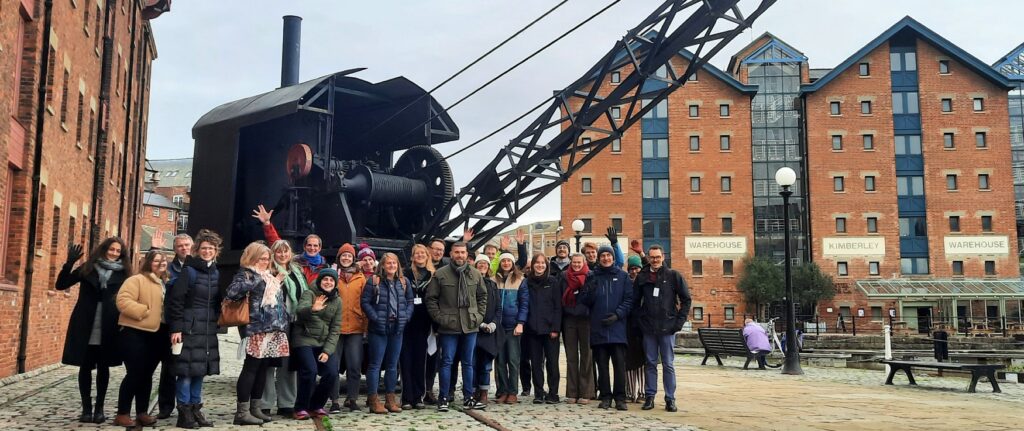
The afternoon featured a series of community vignettes showcasing practical climate action already happening across the county, from natural flood management in Stroud, to community assemblies on food and land use, to emerging community energy initiatives in the Forest of Dean. Gloucestershire Community Rail Partnership also highlighted creative approaches to making travel more inclusive for underserved groups.
Creativity as a tool for facilitating climate governance conversations
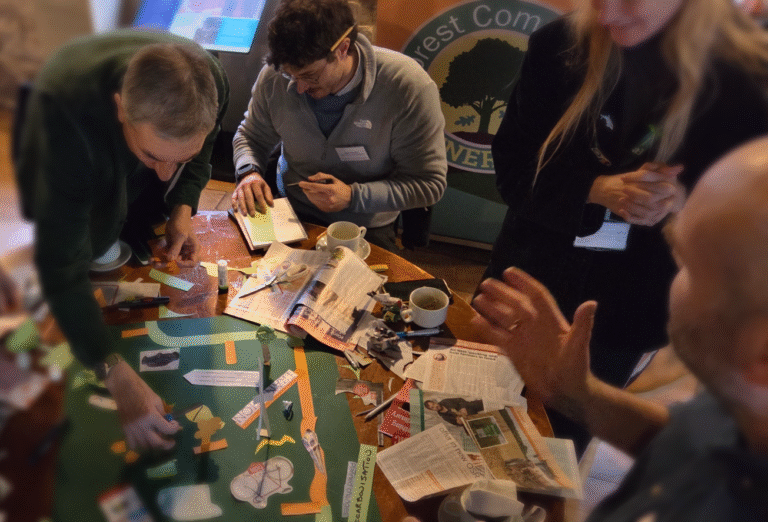
A highlight of the day was a hands‑on zine‑making workshop, led by CCRI’s Dr. Philippa Simmonds (see top image). Participants worked collaboratively with magazines, photos and craft materials to explore one key question:
How can decision‑makers best engage and support rural communities
on their net zero journey?
The resulting A1 zine pages covered themes from youth transport to nature recovery, and demonstrated how creative methods can unlock new conversations, perspectives and connections. You can see the final zine, created with UoG illustration colleagues, here: Community Engagement for Net Zero Governance – Research Repository.
Looking ahead
The workshop demonstrated a strong appetite for more participatory, community-centred approaches to climate governance. You can read the full workshop report here: Community engagement for net zero governance: Stakeholder workshop – Research Repository
CCRI will continue working with partners across the county and beyond to support community engagement, share learning, and help shape place-based net zero strategies.