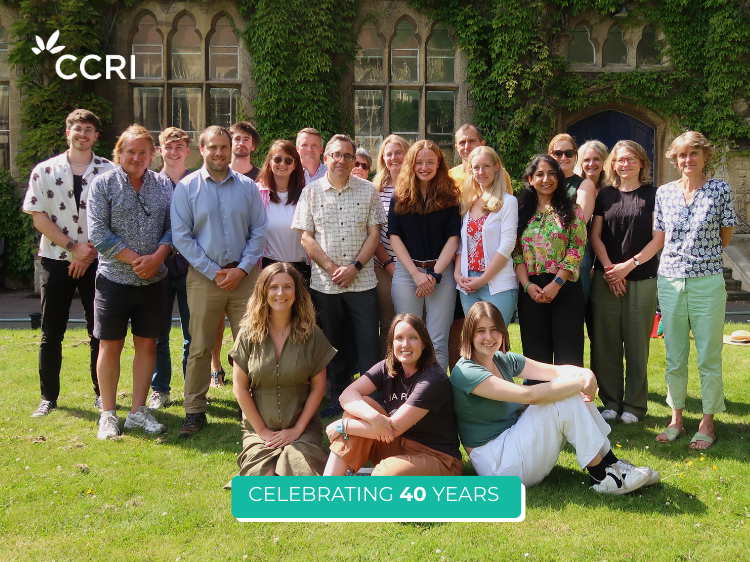
As CCRI celebrate its 40th birthday, we talk to four long-standing members of the team about their time here. From the policy shifts of Brexit to the growing urgency of the climate crisis, they reflect on how an inclusive, bridge-building ethos has made for more effective research.
Who’s who?

Alice Goodenough
Alice first joined CCRI in 1999 as a PhD student. Following a 15-year period working primarily in the third sector, she re-joined in 2021 as a Research Fellow and is now our Postgraduate Research lead.

Chris Rayfield
Chris is CCRI’s Business Manager. He joined CCRI in 2006 and is responsible for research project, contract and financial management.
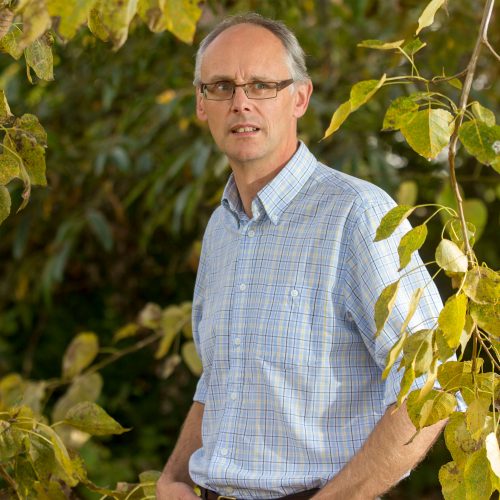
Chris Short
Chris has been with CCRI since 1995 when he joined as a Research Assistant. He is now Associate Professor in Environmental Governance.
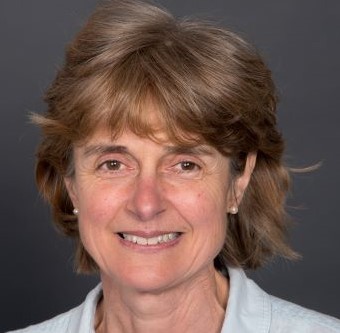
Julie Ingram
Julie joined CCRI as a PhD student, back in 2000. She is now Professor of Innovation for Sustainable Agriculture.
What struck you most when you first arrived at CCRI?
Chris S: Very warm, very inclusive. What struck me the moment I first came here was that there was no perceivable gap between the professor and the PhD student.
Alice: I started as a PhD student and Nigel Curry, CCRI’s founder, was my first supervisor. He was great: very collaborative, very supportive, just very nice. I’d say the character of CCRI today embodies Nigel’s best attributes that I first saw back then in the late ‘90s.
How has that inclusive ethos shaped the way you approach your work?
“You’ve got to make sure you don’t just ask participants questions and extract their data, only for them to never hear from you again.” – Julie Ingram
Julie: It means that research ethics have become much more important to me. I’m now much more aware and sensitive of how we treat research participants. You know, they are not just research subjects. If you’re asking people like farmers to come for a workshop, you’ve got to try and compensate them or pay travel. You’ve got to make sure that you don’t just ask questions and extract their data, only for them to never hear from you again.
Chris S: We were doing co-design before it had a name! Back in the early 2000s, a group of us had a similar feeling that we wanted to be different. We had a meeting and said, no, we’re not going to do extractive research anymore. That was pivotal. We started to have feedback sessions with the people who we’d been working with, consciously giving something back. I’d always felt very uncomfortable doing that extractive type of work. And, thankfully, we’ve pretty much avoided it ever since.
Chris R: We’ve also made a point of sharing our research with people outside the projects. Social media is of course very normal now, but we started using Facebook and Twitter when they were still novel. We thought we were very clever for using them. It was hard to find universities or even government departments on social media at that time.
“If you’re not telling people about your research, can you really say you even did it?” – Chris Rayfield
Chris S: Although we are academics, sometimes we don’t feel very academic. Do you know what I mean? We’ve never been an ivory tower, or anything which is too impenetrable.
Alice: We very quickly realised on the UK Treescapes programme that research communications is not an ephemeral part of the work. It’s a mainstay. We have to be telling people what’s coming out of this programme. Otherwise, there is just no point to what we’re doing.
Chris R: If you’re not telling people about your research, can you really say you even did it?
What does that ethos look like in practice when you’re working with research partner?
Julie: Within project teams, we don’t just work with other academics. We work with all kinds of organisations. We have supply chain partners, we have private and practitioner and NGO partners in our projects. It really changes the ethos of the research.
Alice: Transdisciplinary research is really embedded in the CCRI approach. It shifts our thinking and challenges assumptions that you might make. Ultimately, it means that we as academics then have a much better insight into what’s happening in other sectors and what’s important to people, and we can produce more useful research. It does take more time though, and therefore money, but it’s worth it. A lot of relationship building has to go on alongside the research.
“Transdisciplinary research means that we as academics have a much better insight into what’s happening in other sectors and what’s important to people, and we can produce more useful research. It does take more time though.” – Alice Goodenough
Julie: When I joined CCRI in the 2000s as a PhD student, my supervisor, Carol Morris, was part of one of the first interdisciplinary programmes, the Rural Economy and Land Use (Relu) Programme, which was a collaboration between the research councils. Now, inter- or transdisciplinary working is mainstreamed but it was it was a big deal in those days.
Alice: Transdisciplinary research is also a key part of the collaborative PhD studentships that we offer through the Welsh Graduate School of Social Science. It really helps equip you with lots of transferable skills that are important in lots of sectors, not just academia. By the time you graduate, you will have worked with a lot of different communities and managed those relationships.
Looking back, how has CCRI evolved during your time here?
“The ethos of CCRI has always remained the same. Inclusive, flexible, positive. We’re always trying to find out how things can be better.” – Chris Short
Chris R: The scale of what’s going on is the real change for CCRI. There are many more of us, projects are much bigger, we have more postgrad research students.
Chris S: Yes, we are clearly a lot bigger now. Also, when I started there were very few women. Now CCRI is majority female, right up all scales, which is a really positive thing.
Julie: Becoming bigger has allowed us to broaden our scope of research with topics and approaches. We’ve expanded our expertise into food systems, forestry, soils, energy, biodiversity, fisheries…
Chris S: I would say the ethos of CCRI has always remained the same though. Inclusive, flexible, positive. We’re always trying to find out how things can be better.
How has the shift to digital ways of working over the years changed how you work?
Alice: It has had a huge impact on how we do research. Before, everything was literal field work. You know, for one of my PhD case studies, I lived in Cornwall for a couple of months. And when I returned to academia during the pandemic, I found it really odd that everyone was on Teams all of a sudden.
Going into the field is still really important, face-to-face work really matters. But digitalisation has enabled other forms of collaborations. You can reach more people and deliver at a faster pace. I’m amazed by the quality of relational connections you can make online.
Chris R: I don’t think CCRI could have grown as it has without digitalisation. It allows you to effectively manage people’s time. You can easily see what you’ve done and where you’re going and what the opportunities are that perhaps you’re passing up if you don’t have time.
Twenty years ago, everything was on paper. And that meant things had to be simpler and slower. Digitalisation has allowed research projects to become more complex, with complex teams. If you look at the big EU and UKRI projects, you have people doing the actual research but now there’s a lot more management stuff plus communication and dissemination too.
Alice: I can remember the feeling of going to give a presentation early in my PhD, really nervous. In those days, you had to use a projector, with – what were they called? The clear film? Acetates! You had to get them printed in advance, so it was a big commitment. You couldn’t tweak your presentation at the last minute
Chris R: I had to photocopy vast reams of stuff to distribute calls for tenders or research specifications. Then I’d put them in a great big envelope and send them off or, in the case of the Countryside Agency or Commission for Rural Communities, I’d just walk into Cheltenham carrying an armful of the things. Now it’s all done with the click of a button.
What else has changed the direction of your work?
Julie: Things that happen in the wider world can completely shift how you work. The pandemic was a huge one, obviously. But policy changes also affect what we work on, assessing the impacts of policy changes and new conditions for farmers. Brexit has, surprisingly, brought new opportunities in this respect. And, in my case, the urgency for net zero has certainly brought more funding.
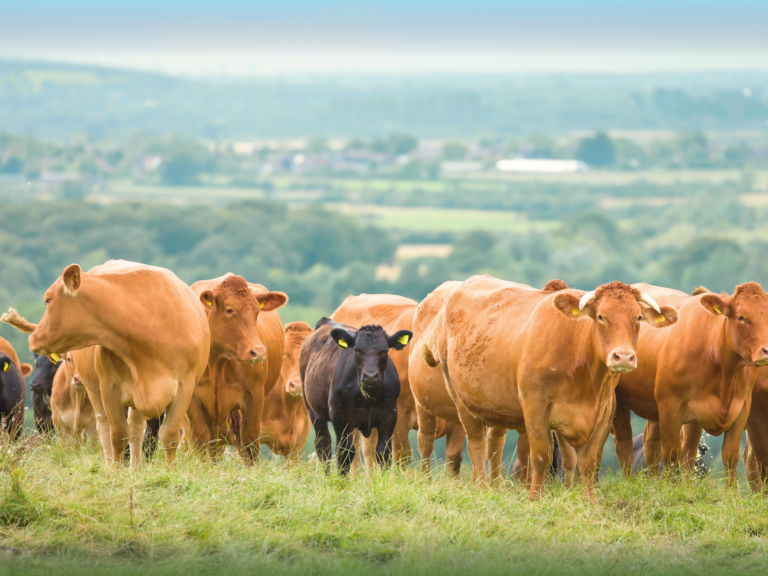
Chris S: I remember the effects of the BSE outbreak on a particular project. It was absolutely tragic for farmers, but it also messed up our research. The outbreak hit right in the middle. I was interviewing farmers and then all of sudden they were saying they weren’t going to keep beef cattle anymore. So it skewed all our data.
And finally, looking ahead, what do you see on the horizon for CCRI?
“It’s an omni-shambles. Climate, biodiversity crises… But I can see that we are really trying to innovate to try to understand and meet these really wicked problems.” – Alice Goodenough
Chris S: I wish we didn’t have to still talk about climate change, but we do. And we are brilliantly positioned, I would say, to keep researching it. There are lots of other messes that we’ve got to sort out too: nature, food security…
Alice: It’s an omni-shambles. Climate, biodiversity crises, they’re all combined. But I can see that we are really trying to innovate through trans-disciplinary collaboration and innovative theoretical perspectives and methodological approaches, to try to understand and meet these really wicked problems. You can feel the energy.
Julie: The climate emergency will always be an important research topic. With global geopolitics being what it is, we may need to also focus more on national security, and food and energy supplies.
Chris S: The key thing for the future for me is, I absolutely think CCRI is in safe hands. I look around, I think, wow, we’ve got some seriously bright people here. I have no qualms on that front.
You may also be interested in reading:
Forty years of the CCRI: a story of expansion and a quest for inclusion

Stay connected. Sign up to the CCRI newsletter.