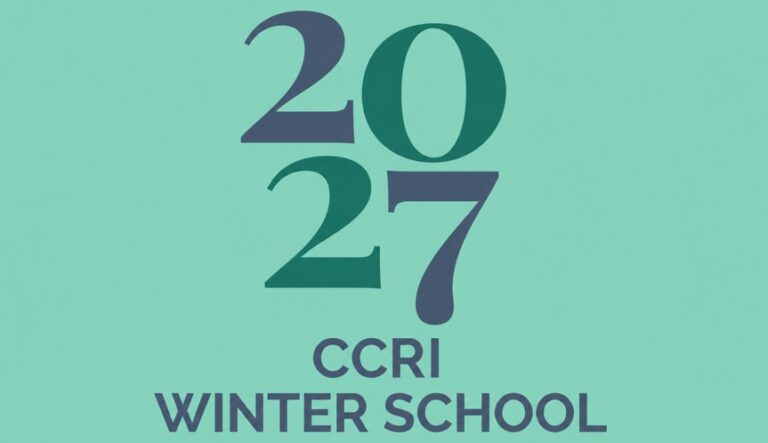
The annual CCRI Winter School takes place on Thursday 21 and Friday 22 January 2027 and is inviting submissions on the theme of Social and Environmental Justice.
The theme for the 2027 CCRI Winter School is Social and Environmental Justice. We welcome contributions (including papers and workshop proposals) that explore justice in relation to social, environmental, economic and political change.
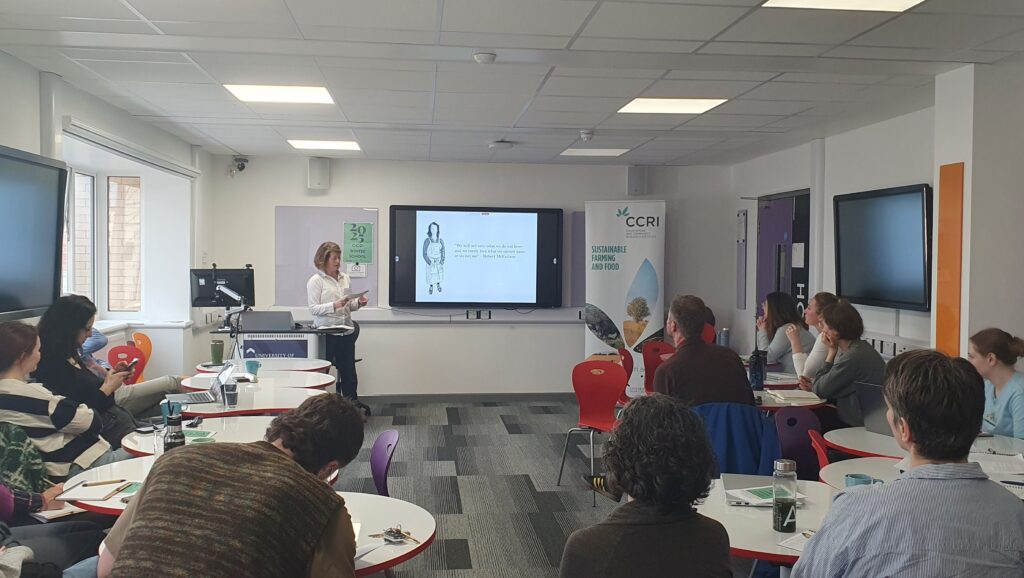
The two-day Winter School provides an opportunity for current UK-based PhD researchers to present work-in-progress to a group of peers in a conference style setting.
- Audience members will also include staff and post-graduate students from across the University of Gloucestershire’s School of Arts, Creativity and Environment.
- Experienced staff from the CCRI will be on hand to provide constructive and supportive feedback. CCRI is recognised as an internationally excellent research institute by the ESRC and is a member of the Welsh Graduate School for Social Sciences.
Social and environmental justice
In the context of multiple and overlapping crises, there has been increasing recognition that transitions towards more sustainable futures must be ‘just’ to achieve popular support and acceptance (Williams & Doyon, 2019). The concept of ‘just transition’ has been employed within the field of climate justice, for example, to capture the necessity of distributing the impacts of lower-carbon lifestyles equitably if these shifts are to be sustained (Ibid). Within the same field, it is acknowledged that forms of social and environmental injustice frequently intersect and that critical thinking, flexibility and collaboration across disciplines and communities are needed to research these intersections effectively.
What has also become evident in the study of the social dimensions of climate change is that as we attempt to negotiate climate risks at pace, ideas of what is ‘just’ are frequently deployed in competition, politicising and sometimes paralysing debate with consequences for academia, policy and practice (Fischer et al., 2024, Malin & Ryder, 2018).
In light of such findings, this Winter School invites reflections on the practice of research into and supportive of social and environmental justice. Contributions could explore:
- Novel engagements with notions of social and environmental justice
- Critical reflection on how key concepts within social and environmental research (including, but not limited to, resilience, adaptation, vulnerability, sustainability, security, participation or transition) support or risk justice
- Exploration of how social and environmental (in)justice intersect, reinforce one another, and shape possibilities for change
- Methods and practices for increasing fairness, inclusion, participation, representation and recognition with research and avoiding the reproduction of injustice
- Practically navigating and managing encounters with (in)justice in the field
- When and how should researchers adopt roles as facilitators, advocates or activists for justice within their field and what enables and challenges such engagement
“The Winter School’s combination of intellectual rigour alongside genuine openness creates a space where ideas can be tested, challenged, and reshaped without the pressure of needing to present something “finished”.”
Learn how the Winter School has helped PhD researcher Josh Davis >>
The CCRI Winter School: reflections on change, continuity and creativity in research

How to apply
Please send abstracts of 250 words maximum, alongside your contact details and host institution to Alice Goodenough (agoodenough@glos.ac.uk) and Aimee Morse (amorse1@glos.ac.uk) by 12 noon on Friday 6 November. We will be in touch with a decision by Friday 13 November.
We welcome abstracts from UK-based PhD students at any stage of their studies (from engagements with the literature, and theoretical and methodological deliberations, to presentations of results, outcomes and impact).
The CCRI frequently focuses on rural research and exploring people and environment relationships from social science and humanities perspectives, and related contributions are invited. However, the Winter School is open to post-graduate researchers from any field and discipline who feel they will benefit from its approach. Previous participants’ backgrounds have ranged widely through the disciplines.
Attendance at the Winter School is free of charge, however, successful applicants will need to cover the cost of their travel and accommodation in Cheltenham.
References
Williams, S., & Doyon, A. (2019). Justice in energy transitions. Environmental innovation and societal transitions, 31, 144-153.
Fischer, A., Joosse, S., Strandell, J., Söderberg, N., Johansson, K., & Boonstra, W. J. (2024). How justice shapes transition governance–a discourse analysis of Swedish policy debates. Journal of environmental planning and management, 67(9), 1998-2016.
Malin, S. A., & Ryder, S. S. (2018). Developing deeply intersectional environmental justice scholarship. Environmental Sociology, 4(1), 1-7.
Mikulewicz, M., Caretta, M. A., Sultana, F., & JW Crawford, N. (2023). Intersectionality & climate justice: A call for synergy in climate change scholarship. Environmental Politics, 32(7), 1275-1286.

Stay connected. Sign up to the CCRI newsletter.